


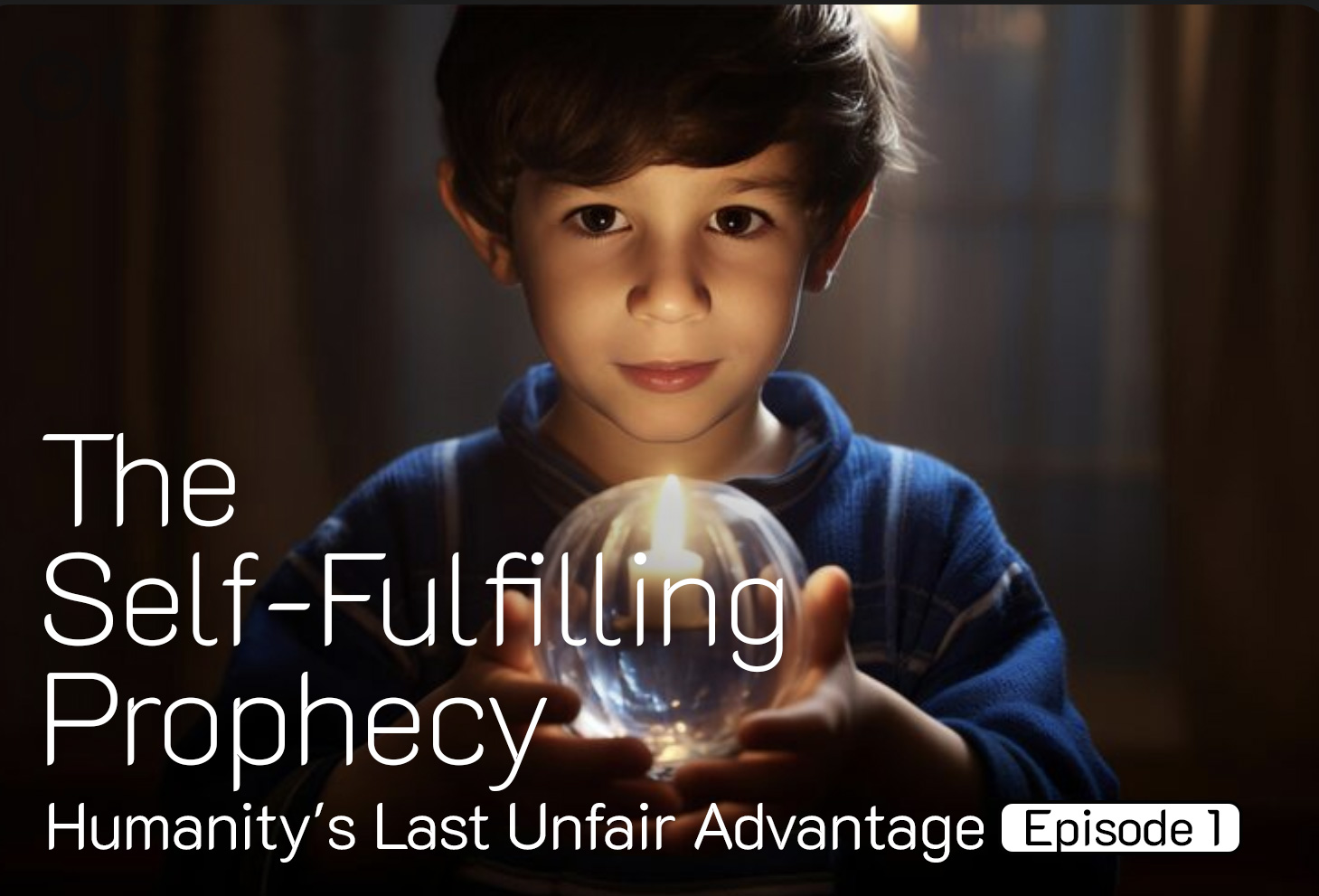




This line, written long before artificial intelligence entered everyday life, captures our moment with surprising accuracy.
We now stand at the foot of a mountain called Artificial General Intelligence. Some look up and see an avalanche — a force poised to bury careers, creativity, and purpose itself.
They see machines rising, and so the age of AI becomes a zero-sum war: human against silicon, scarce resources, inevitable defeat.
This is the prophecy of fear. And like every self-fulfilling prophecy, it needs our belief — and our participation — to come true.
The alternative is not to halt the mountain. It is to change what we see when we look at it. Not an avalanche, but a new landscape. Not a rival, but a collaborator. The future of our species in an AI world will hinge not on the raw power of the technology, but on the quality of our perception. And that perception is shaped by how we educate the minds coming next.
This brings us to our children — the alchemists of the AI age.
Raise them to view AI as a crutch, and they will grow dependent and weak. Raise them to see it as a substitute for thinking, and they will outsource curiosity to chatbots and judgment to algorithms. They will become perpetual passengers in a world steered by autonomous systems — trading potential for convenience.
But what if we raised them to co-create with AI instead?
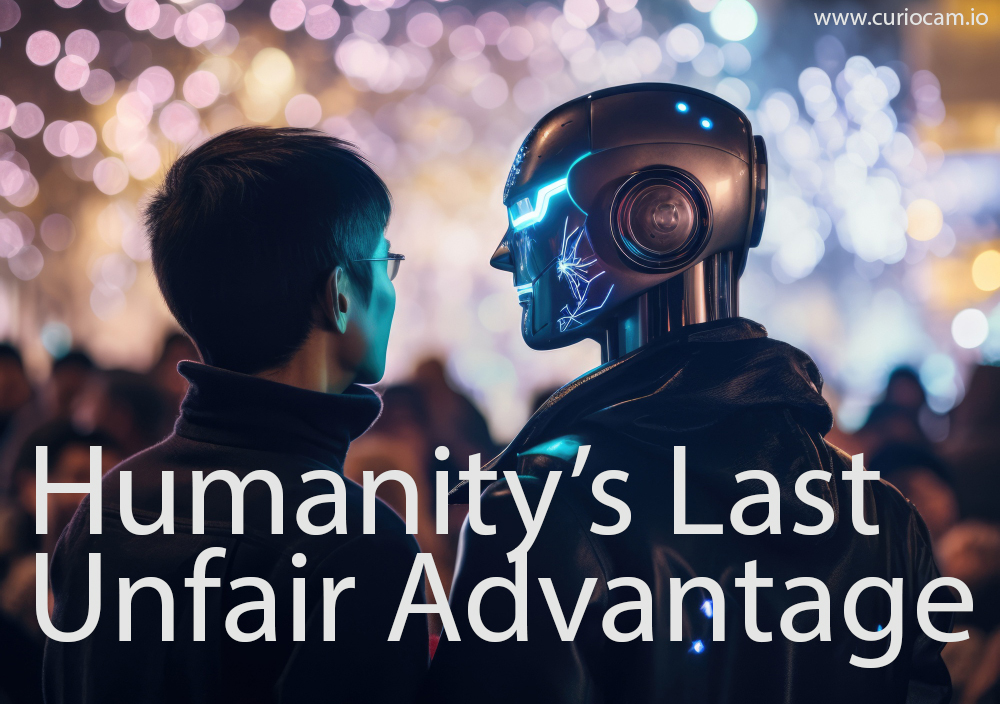
The goal is not to outrace machines at what they do best. It is to double down on what remains uniquely human. Our last unfair advantage is no longer a single skill AI can't touch — those are disappearing fast. It is a posture toward the world: the cultivated habit of mind that turns intelligence (ours and the machine's) into something greater.
We must teach children to:
- Acquire knowledge with purpose — not just retrieving facts, but weaving them into coherent, personal understanding.
- Grow intellectual capacity — treating the mind as a muscle strengthened by hard problems, not softened by auto-complete.
- Bounce ideas recklessly — embracing the messy, joyful collision of human minds where sparks fly between people in ways no model can replicate alone.
- Think independently — finding the courage to hold a conviction unprompted by trending data or popular prompts, and to ask "why?" when the machine answers "because."
- Test assumptions relentlessly — using AI as a rigorous sandbox to simulate, challenge biases, and validate (or destroy) hypotheses like true scientists.
This is the new curriculum for humanity.
It doesn't dictate what to think; it teaches how to engage with thinking itself. It treats AI not as a classroom intruder, but as the ultimate Socratic partner: tireless devil's advocate, infinite sounding board, playground for imagination.
The world our children will inherit is one we are already co-creating with our machines. Whether it becomes a hostile takeover or a renaissance of human potential depends on the alchemists we raise.
Will we teach them fear — and manifest a world that justifies it? Or will we teach them curiosity, resilience, and agency — arming them to architect their own intelligence alongside AI, so that humanity's last unfair advantage becomes the one we deliberately choose to cultivate: an awake, courageous, meaning-seeking human spirit?



Join the discussion